
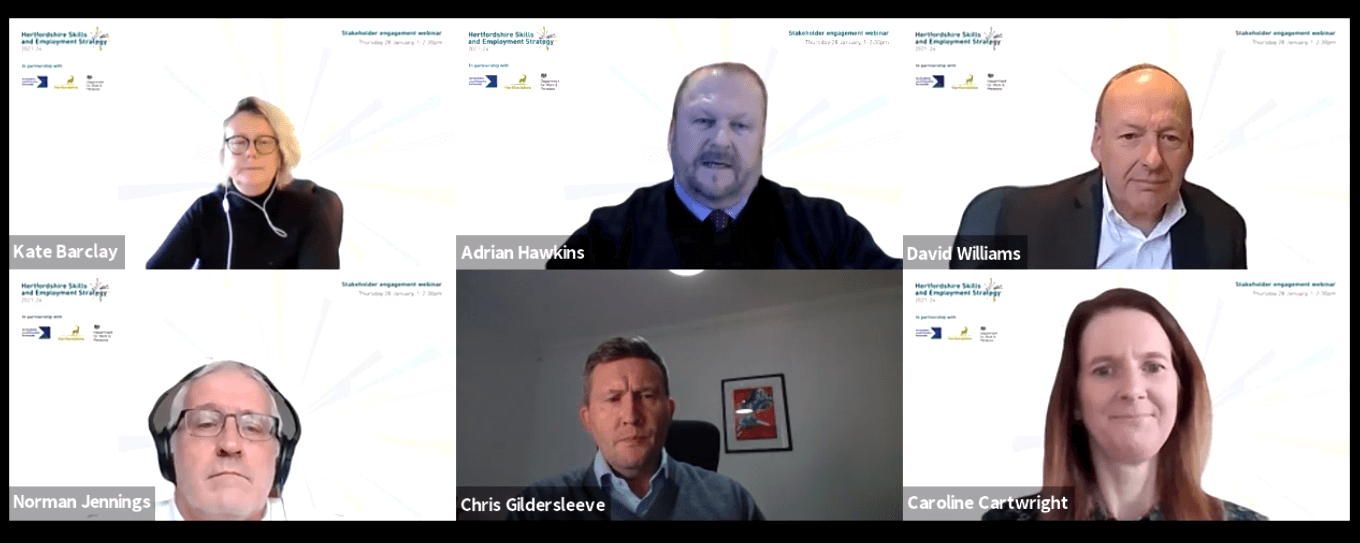
Hertfordshire’s key decision makers have unanimously agreed a joined-up countywide approach to skills and employment will be key to unlocking Hertfordshire’s long-term economic growth and future prosperity at a webinar facilitated by White Label.
Nearly 100 stakeholders from across business, local government and education, attended the first of two webinars, hosted by White Label on behalf of Hertfordshire County Council, Hertfordshire LEP and the Department of Work and Pensions (DWP), on 28 January to help re-shape the Hertfordshire Skills and Employment Strategy in the light of COVID-19 and provide a route-map for recovery and sustainable growth up to 2024.
The pandemic has had a particularly adverse effect on the employment opportunities of the classes of 2020/21 and other school leavers, apprentices and older workers with those from BAME groups, the disabled, women and the lower-paid in society disproportionately affected. The strategy is being updated for a third time to reflect the current economic landscape and continue to provide collective leadership on skills development.
Cllr David Williams, Leader, Hertfordshire County Council, said: “With the impact of the COVID-19 pandemic likely to be felt in the county for some time, it is more important than ever that we continue to work together to address these challenges in order to accelerate Hertfordshire’s economic recovery.
“The development of the third edition of the Hertfordshire Skills and Employment Strategy, supported by the recovery plan, Unlocking Hertfordshire, supports our commitment to provide a clear road map for how we can ensure the county’s workforce has the right skills to encourage sustained economic growth for years to come.”
Stakeholders were asked to share their views on emerging cross-cutting themes focusing on:
• Enhancing digital skills: to ensure Hertfordshire fully maximises its potential;
• Supporting Hertfordshire’s ‘Net Zero future’: to drive Hertfordshire’s move to clean growth;
• Social inclusion and diversity: to create opportunities for all by putting in place strategies to encourage greater social mobility.
The Strategy sits alongside Hertfordshire’s wider Economic Recovery Plan, Unlocking Hertfordshire, which puts people at the heart of recovery. It will also seek to address the impact of EU Transition, focussing on Hertfordshire’s workforce and labour migration. Produced by Hertfordshire LEP, Hertfordshire County Council and the DWP, the Strategy has been in place since 2015 and is a dynamic driver of enterprise, investment and key sector growth, helping to ensure the county’s workforce and future labour market is best equipped to meet employers’ needs.
The event was opened and chaired by Adrian Hawkins OBE, Chair of Hertfordshire LEP’s Skills and Employment Board, who said: “In such challenging economic times, the need for partnership working to ensure we have the skills for the future has never been greater. The strength of this strategy lies in that collective leadership and also our dialogue with stakeholders. Here in Hertfordshire we have the mechanisms in place, both at a strategic and operational level, to ensure we can continue to support our employers’ needs by building a skills pipeline to support their future recovery and growth during and after the pandemic and EU transition.
“With the government’s renewed emphasis on employer engagement and employer-led skills delivery, we need to ensure an exciting and easy delivery of information and support options exist to ensure employers can engage with our schools, colleges and universities. Our central resource HOP (www.hopinto.co.uk) delivers this by providing up to date information on skills and employment opportunities.”
DWP Universal Credit Service Leader Chris Gildersleeve said: “Working together collaboratively is the only way that we will provide our residents with the very best wrap-around support enabling them to find their way back into employment. This includes working intensively to support those with barriers to work, our young residents who have been disproportionately affected whilst supporting our worst affected places and sectors.”
Other speakers included Norman Jennings, Director of Operations, Hertfordshire LEP; Dr Kate Barclay who spoke on the importance of growing the skills needed to support our key sector industries, such as the thriving cell and gene therapy cluster in Stevenage, and Caroline Cartwright, Skills, Employment and Apprenticeship Lead for Hertfordshire LEP, who set out the proposed themes for the revised strategy.
Immediate feedback generated through live polls demonstrated the audience was positive about the approach taken so far – as 78% strongly agreed and 22% agreed with the need to have a county-wide partnership approach to the development of the strategy; and 41% strongly agreed and 55% agreed with the themes proposed and cross-cutting priorities.
The next webinar on 25 February, 1pm – 2.30pm, will be an interactive session that will go into more depth about the proposed themes. You can book your place here.
A recording of the first webinar and presentations can be found on the Hertfordshire LEP website.

